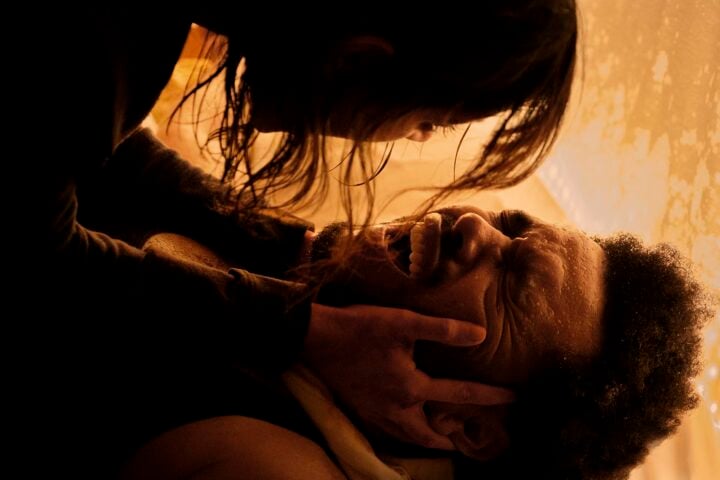
Riley Keough and Gina Gammell’s War Pony embodies the unconventional spirit that’s marked the former’s acting career. Shot on location at the Pine Ridge Indian Reservation in South Dakota and starring a cast of indigenous Lakota non-actors, the film details the daily struggles of a hustler, Bill (Jojo Bapteise Whiting), and a neglected middle-schooler, Matho (LaDainian Crazy Thunder). Structured in intertwining storylines, War Pony possesses a gritty essence, but for however uncompromising its glimpse into Bill and Matho’s stagnantly bleak existences may be, the film also feels generic in execution.
This can be chalked up to War Pony’s glaring, almost frustrating lack of nuance or specificity, as the filmmakers never effectively detail the characters’ relation to the various cultural, psychological, or historical intricacies of their milieu. Instead, they’re almost stubbornly focused on capturing an unflinchingly unvarnished view of day-to-day life on society’s fringes.
The product of a long collaborative process, the film follows the dual—and at times redundantly similar—exploits of poverty-stricken Bill and Matho as they struggle to eke out a living. For the former, it’s as an amateur dog breeder and doing odd jobs for Tim (Sprague Hollander), a local turkey farmer, whereas the latter follows in his father’s footsteps and starts dealing drugs.
War Pony’s approach has the unintended effect of making these parallel narratives feel as if they’re little more than a generalized depiction of the downtrodden in Anywhere, U.S.A. Throughout, we only catch glimpses of the unique characteristics of the Lakota tribe’s world, as in a brief sequence that takes place at a traditional festival, where Matho tries to woo a girl after she performs a ritualistic dance. That these snapshots of tribal living are predominantly relegated to innocuous transition shots only reinforces their peripheral nature.
And yet, those glimpses can be striking. This is especially the case when the filmmakers convey a contrast in the lives of the film’s indigenous youths, where old traditions clash with the alluring pleasures offered by their peoples’ enduring tormenter: the capitalist, colonizing force of America. At the very start of the film, a Lakota elder chants beside a small fire on the plains, and suddenly we cut to Bill smoking pot and blaring hip-hop while cruising in his car.
The moment hints at a richer exploration of generational tension and the slow erasure of a culture, in the vein of Reservation Dogs. But as that exploration is largely unfulfilled, and because the filmmakers never capably engage with the narrative’s singular world, we instead get something a little closer to a reservation-set retread of Larry Clark’s Kids.
Since 2001, we've brought you uncompromising, candid takes on the world of film, music, television, video games, theater, and more. Independently owned and operated publications like Slant have been hit hard in recent years, but we’re committed to keeping our content free and accessible—meaning no paywalls or fees.
If you like what we do, please consider subscribing to our Patreon or making a donation.