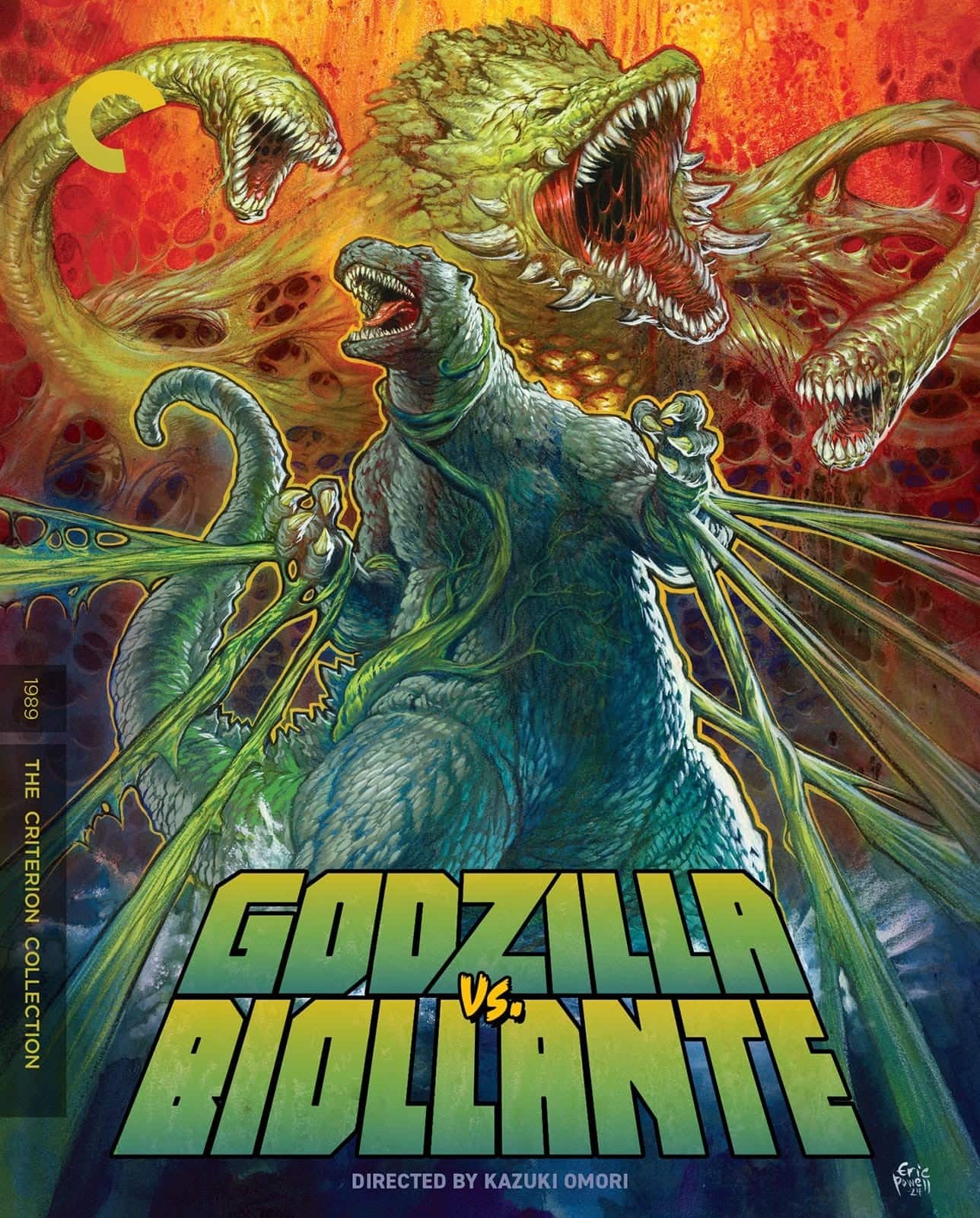
 Ômori Kazuki’s Godzilla vs. Biollante opens immediately after the events depicted in 1984’s The Return of Godzilla, showing agents from two private biomedical firms descending on the site of Godzilla’s carnage to collect his cells for genetic research. Not merely content to raid the scene, these competing companies sic mercenaries on each other to ensure a monopoly on future bioengineering breakthroughs. This leads to an attack on the lab of scientist Shiragami Genshiro (Takahashi Kôji) that, as he works on creating super crops by modifying plants with Godzilla’s cells, results in the death of the researcher’s daughter, Erika (Sawaguchi Yasuko).
The quality of a Godzilla film often resides less in the spectacle of the monster’s tussles with military forces and other kaiju than in the human drama. In a wayward attempt to both preserve his original research and some aspect of his lost daughter, Shiragami creates a hybrid mutant that he christens Biollante by merging cells from Godzilla with those from a rose and Erika, and the film builds a substantial level of political intrigue and emotional drama into the creation of the kaiju and it going rouge. After rapidly growing in size, Biollante escapes containment, reigniting the violent actions of the rival companies and eventually unleashing Godzilla from the mountain where he’d been trapped at the end of The Return of Godzilla.
Viewed from a distance, many of the elements here—mad-scientist experiments, psychic children, post-national corporate espionage in the vein of William Gibson—feel like updates of the Showa era’s most ludicrous excesses. Here, though, they’re filtered through the grounding elements of Shiragami’s grief for his lost daughter and of an anxiety over unchecked technocratic capitalism that eerily presages the abrupt, catastrophic end of Japan’s economic miracle starting in 1990. Biollante itself updates the environmentalist slant of 1971’s Godzilla vs. Hedorah with contemporary anxieties over the possibilities of genetic modification, adding a new dimension to the franchise’s ever-shifting subtextual interests.
When the kaiju action does come, though, it’s outstanding. The Godzilla suit comes in for one of its regular updates and emerges looking more malevolent than it has since Honda Ishirô’s original Godzilla. His face drawn into a permanent scowl, Godzilla is perpetually baring his teeth, and the extra effort that went into giving the suit an undulating tongue adds a more naturalistic touch to the erstwhile stiffness of his canned roars.
But the star of the show here is Biollante. The imaginative and intricate touches that went into animating its vine-like appendages and undulating maw of a pistil are enough to make the kaiju the greatest practical-effects monster that the franchise has ever produced. Biollante’s genetically engineered properties allow it to keep evolving, culminating in a grotesque final form of a crocodilian snout and tentacles with independent mouths snapping and stabbing Godzilla in one of the nastiest final fights in the series. Even more so than its predecessor, Godzilla vs. Biollante reasserts the primal terror of its monster protagonist for the Heisei era, pouring cold water (and green blood) on Japan’s economic bubble just before it burst.
Image/Sound
The transfer for this release, sourced from Toho’s recent 4K restoration, shows a few instances of aggressive clean-up. Some shots have an unnaturally boosted sharpness that clashes with the look of the overall presentation, which is otherwise defined by soft daytime whites and inky, slightly smoky night battles. It’s in those moments that the transfer shines, ably showing off subtle gradations of color against the neutral tones of government and scientific facilities and deep black levels during Godzilla and Biollante’s nighttime rampages.
The 5.0 surround DTS-HD Master Audio soundtrack superbly mixes ambient city noise, the din of kaiju battles, and the subtle orchestrations of Sugiyama Koichi’s alternately tender and pulsing score. Through it all, dialogue is never drowned out, with the deep bass rumbles that accompany every kaiju step hammering home the immensity of the skirmishes.
Extras
Criterion’s release comes with a new commentary by critic Samm Deighan, who discusses the overarching relevancy of the franchise, its political awareness, and Ômori Kazuki’s career, including his role in co-founding the legendary Japanese independent production studio Director’s Company in 1982. A 50-minute archival making-of documentary provides wonderfully illuminating behind-the-scenes footage of special effects supervisor Kawakita Koichi’s work on the film, and an additional, brief video on the miniatures that Kawakita crafted spotlight the care that went into even the non-suit effects. A booklet essay by critic Jim Cirronella celebrates the film’s role in restoring Godzilla to its status as an ongoing engagement with Japan’s domestic and international sociopolitical anxieties.
Overall
The Criterion Collection does justice to one of the finest installments in the Godzilla franchise with a lovely transfer and informative extras.
Since 2001, we've brought you uncompromising, candid takes on the world of film, music, television, video games, theater, and more. Independently owned and operated publications like Slant have been hit hard in recent years, but we’re committed to keeping our content free and accessible—meaning no paywalls or fees.
If you like what we do, please consider subscribing to our Patreon or making a donation.