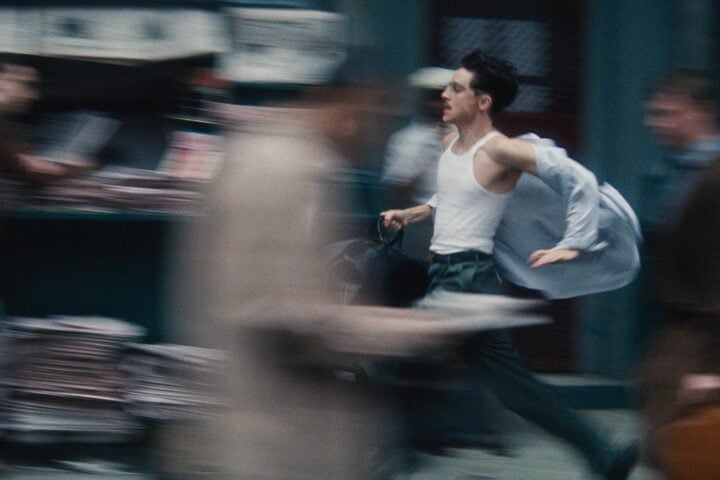
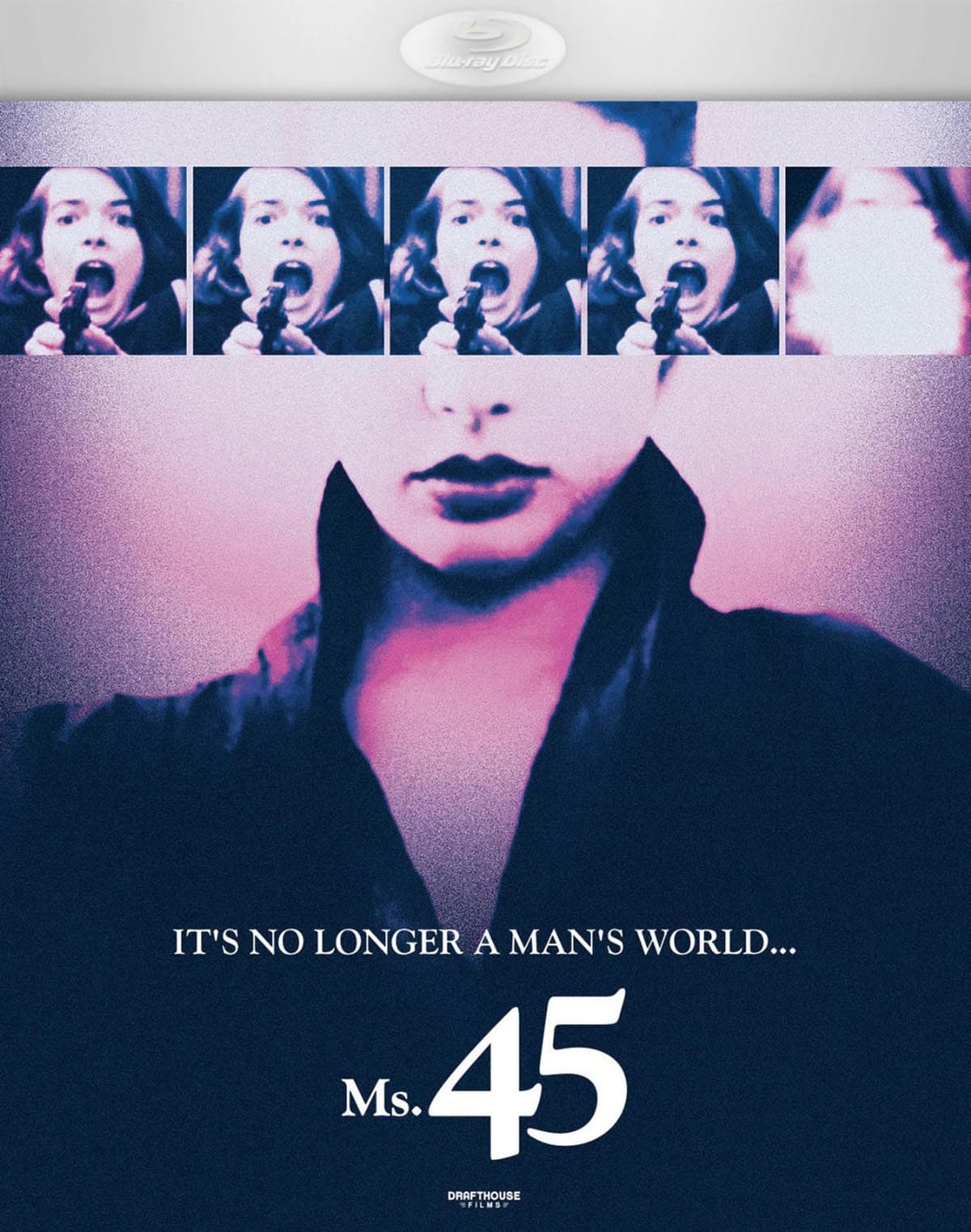
 Rape and revenge movies are inherently muddled in their ideology, eroticizing every assault while pretending that the subsequent bloodletting stands as an unambiguously pro-woman stance. But Ms. 45 expressly foregrounds its thematic confusion. Abel Ferrara’s 1981 exploitation thriller isn’t about justified comeuppance, but rather the mental collapse of a deeply traumatized individual, whose actions are merely a perpetuation of senseless violence.
To even call Ms. 45 a revenge film is to miss how quickly mute garment worker Thana (Zoë Lund) gets back at her attacker. Or one of them, at any rate. The film begins with Thana coming home after work, being raped in an alley, then arriving home only to surprise a burglar, who also rapes her until she fights back and caves in the man’s head with an iron.
For the remainder of the film, Thana targets men who fit various chauvinistic archetypes but don’t scan as grotesque caricatures. Scenes depicting an abusive pimp and gangbangers getting theirs blend with no discernible order with Thana’s less righteous attacks, like that of a catcalling loser who follows her in order to return the bag of victims’ clothes she deliberately drops. Most everyone is overdue for at least a dressing down, if not a harassment suit or even some jail time, but no sense of vicarious justice comes from Thana’s spree.
With porcelain skin and lips you could spot two boroughs over, the then-teenaged Lund looks like she walked out of an exploitation producer’s perverted dreams, yet even performing in her first movie, she projects such intensity and command of expression that when Thana unloads a clip into some poor bastard, it’s hard not pay attention to anything but her face.
On paper, Thana comes off as a collection of signifiers, from her name (reminiscent of Thanatos, the Greek god of death) to her muteness as a physical manifestation of the passive and sometimes active silencing of abused women. As Lund plays her, though, Thana is as terrifying as she is believable in her extremity, and every bit as much as the bit players and extras who appear across the film, which at times scans as a documentary of pre-gentrification New York City. Even when she shows up for a final massacre wearing an eroticized nun’s habit, Thana blows right past symbolism to be simply, inescapably present.
Ms. 45 also represents a notable artistic leap forward for Ferrara following The Driller Killer. He often takes sophisticated direction to the proceedings, as in the high-angle establishing shot of the killing of the gangsters who follow Thana, with the men arranged in a star pattern around her. It’s a moment that may leave you believing that you’re watching a spaghetti western.
Ferrara’s camera is as crucial to giving voice to Thana’s interiority as Lund. Ms. 45 announces its artistic and thematic ambitions even in the rape scenes, in which the camera not only skirts gratuitous nudity, but remains fixated on Lund’s face as she contorts in silent screams and, finally, as her eyes go slack, transporting herself to some far-off place where no harm can come to her. Elsewhere, close-ups spiked with Joe Delia’s score of street-scuffed disco, funk, and jazz orient even innocent interactions around Thana’s caged-animal response, and the slow motion of the climax emanates as much from her sense of purpose as the bystanders’ frozen terror.
Ms. 45 offers an early glimpse of the postmodern guttersnipe effrontery behind Dangerous Game, New Rose Hotel, and Go Go Tales. Whether done to keep costs down or out of conscious awareness of its implications, Ferrara’s decision to cast himself as the first rapist acts as a skeleton key for an entire career predicated on the unavoidable exploitation of filmmaking. As he leaves Thana in a pile of garbage, Ferrara’s rapist hisses, “I’ll see you later, baby,” and as every man but him meets a grim fate, the clear inference is that he’s escaped to behind the camera. That adds even more charge to those frantic close-ups of Thana’s tensing face, and the shots of her pointing her Colt just off screen suggest that she can sense the one that got away.
Image/Sound
Drafthouse Films’ trailer for their restoration looked suspiciously smooth, but fears of DNR appear to be unwarranted. Ms. 45 arrives with its grain intact, and even with a few scratches and reel cue marks left in for grindhouse flavor. Never a crisp film, the movie has an over-lit quality to its daytime shots that gives everything a soft texture. Nonetheless, Drafthouse’s Blu-Ray brings out the most of its splashes of color, be it in the loft where Thana and others sew and prepare clothes to the increasing use of red as the film wears on. The audio track similarly reflects its modest source while complementing it, giving its Foley effects added punch and bringing about all the bass-heavy tension of Joe Delia’s score.
Extras
Interviews with Abel Ferrara, Delia, and production designer Jack McIntyre make up most of the extras, and they all prove interesting, be it Delia talking about his uncertainty in working with Ferrara or McIntyre reminiscing about growing up with Ferrara and getting into filmmaking with him and writer Nicholas St. John. But no one can top the man himself for sheer anecdotal gold, as Ferrara, talking like a hepcat who never got the news that jazz went out of style, recounts the production and especially his working relationship with Zoë Lund and her turn to drug abuse with a combination of humor, pride, and regret that makes him as messy, captivating, and unpredictable as any of his characters. An additional two short films by Paul Rachman about Lund, one with contributions from her husband and one from her mother, are sadder, offering brief, subjective interpretations of her addiction, her erratic life path and losing her too young that are as blunt yet abstract as the films she made with Ferrara.
Overall
Abel Ferrara’s canon of ambitious, autocritical exploitation movies gets its first great high-def with a sympathetic transfer of his essential second feature.
Since 2001, we've brought you uncompromising, candid takes on the world of film, music, television, video games, theater, and more. Independently owned and operated publications like Slant have been hit hard in recent years, but we’re committed to keeping our content free and accessible—meaning no paywalls or fees.
If you like what we do, please consider subscribing to our Patreon or making a donation.