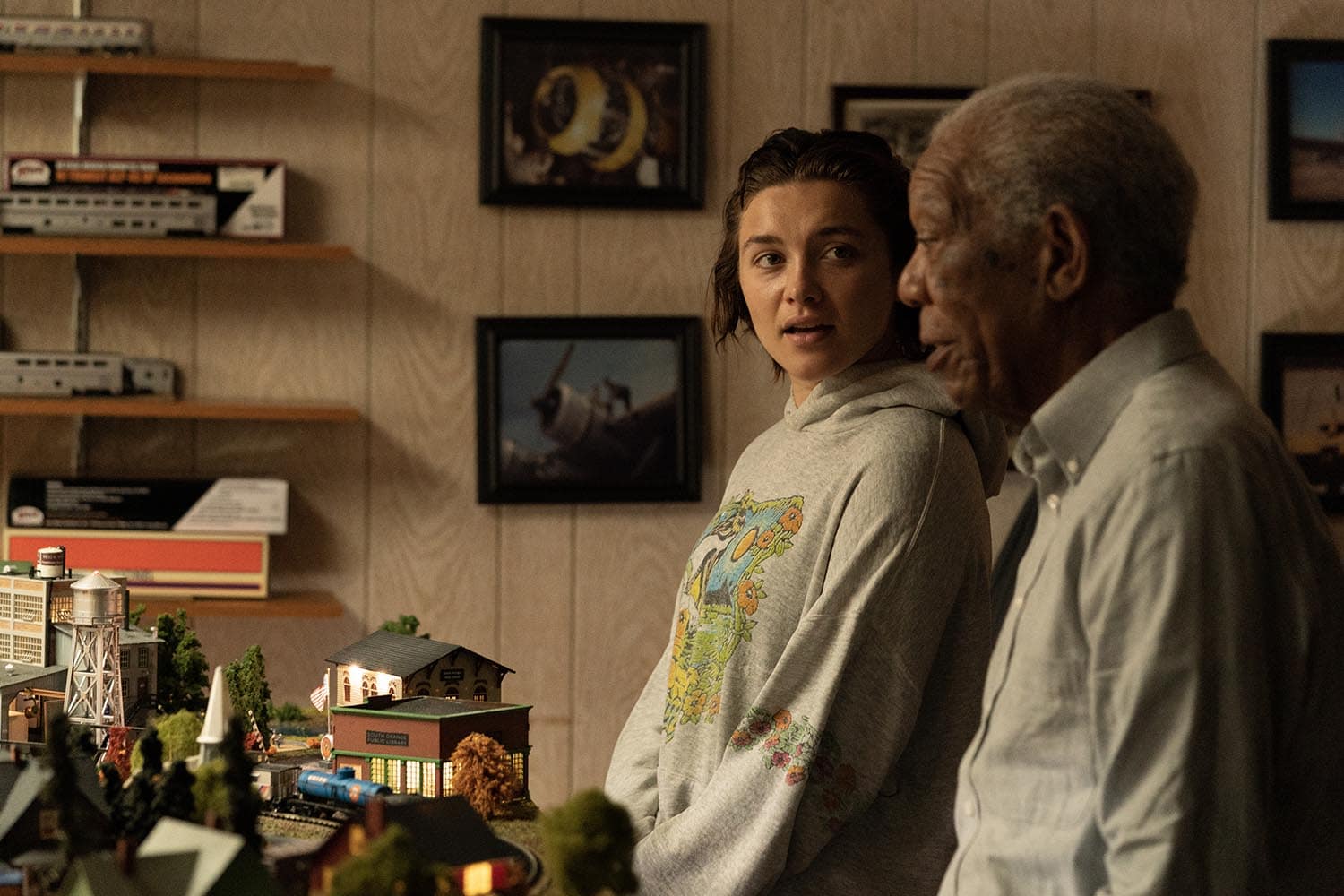
Zach Braff’s A Good Person opens with a bird’s-eye shot of a model train moving through a suburban town dotted with miniature trees and figurines gathered outside their perfectly manicured yards. Over a sappy acoustic song, model train enthusiast Daniel (Morgan Freeman) describes in voiceover the comfort of “lording over a world where the neighbors are always kind” and “the lovers always end up together,” ending with a sudden rejoinder that “in life, nothing is nearly as neat and tidy.” If the bluntest of visual metaphors didn’t clue you in, this heavy-handed warning should prepare you to buckle up. Braff is about to usher us onto the Disillusionment Express and take us straight to Keepin’ It Real Town, New Jersey.
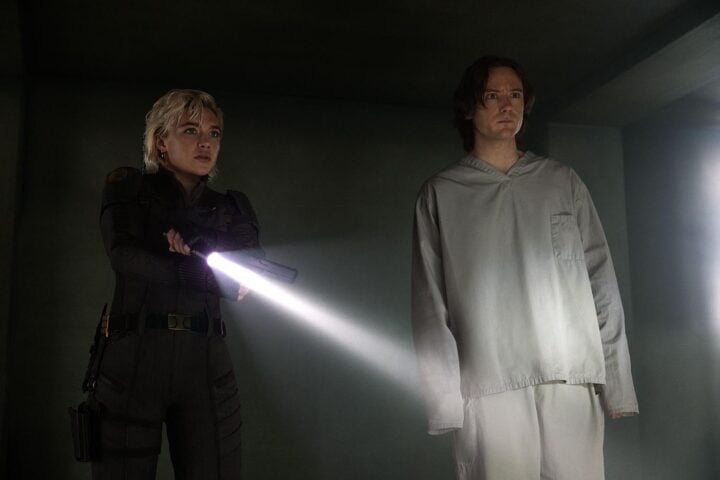
The idyllic vibe of that opening is sustained only briefly in A Good Person as we watch twentysomething Allie (Florence Pugh) serenading her fiancé, Nathan (Chinaza Uche), during their engagement party. Soon after, as Allie is driving to try on wedding dresses with Nathan’s sister, Molly (Nichelle Hines), and Molly’s husband, Jesse (Toby Onwumere), she gets into a car crash that kills her two passengers. Flash forward a year and we find Allie living at home with her mother, Diane (Molly Shannon), addicted to oxycontin and separated from her fiancé.
Initially, the film’s portrait of Allie’s addiction, grief, and survivor’s guilt is delicately rendered, thanks primarily to Pugh’s thorny and spirited performance. In this early stretch, as her character struggles to cope with her ongoing physical pain and mental anguish, Pugh ably captures Allie’s self-destructive impulses and subtle manipulations of others when she’s trying to score more oxy after her mother flushes her last refill down the toilet.
In one especially perceptive scene, Allie ventures out into the world, ostensibly for the first time since her accident, to meet a friend, Becka (Ryann Redmond). At first, Allie sells her desire to get back on her feet, and Becka assumes that she’s looking for help in getting a job. But as soon as we learn that Becka is a former co-worker of Allie’s in the pharmaceutical industry, the façade that Allie is in control of her life collapses and she reveals her desperation, continually pushing her friend for pills, no matter how politely or emphatically Becka refuses.
That scene works so well because it depends so much on Pugh to reveal the hidden depths of her character’s despair and willingness to needlessly burn bridges. And had Braff kept A Good Person focused solely on Allie’s journey to recovery, it might have been a winner. But the filmmaker’s penchant for sentimentality and maudlin melodrama quickly rears its head once Allie runs into Daniel, who’s Nathan and Mollie’s father, at an AA meeting.
While Daniel blames Allie for Molly’s death, which left his teenage granddaughter, Ryan (Celeste O’Connor), in his care, he takes the opportunity to offer the young woman an olive branch. At this point, A Good Person begins to stretch credulity at nearly every turn, having Allie become wrapped up in Daniel’s and Ryan’s lives, despite their continued belief that her looking at her phone was responsible for the fatal accident. All the while, Freeman and O’Connor are both at the mercy of Braff’s baldly manipulative screenplay, with their characters at times being hospitable toward Allie only to reject her a scene later, and vice versa.
Further compounding A Good Person’s contrivances are the reveals of several characters’ tragic backstories, from Allie’s father having left the family when she was a child, to Daniel’s father being abusive, to Daniel’s own abuse toward his son, which left Nathan deaf in one ear. It’s all concocted for maximum emotional impact, yet as the film piles on this excess, it loses all semblance of plausibility as the characters crystallize their inner thoughts rather than expose them through their behaviors. And the more that Braff’s script tries to thematically tie these disparate threads together, the more that A Good Person comes to resemble the very same type of neat and tidy self-contained version of reality that it ironically skewers in its prologue.
Since 2001, we've brought you uncompromising, candid takes on the world of film, music, television, video games, theater, and more. Independently owned and operated publications like Slant have been hit hard in recent years, but we’re committed to keeping our content free and accessible—meaning no paywalls or fees.
If you like what we do, please consider subscribing to our Patreon or making a donation.