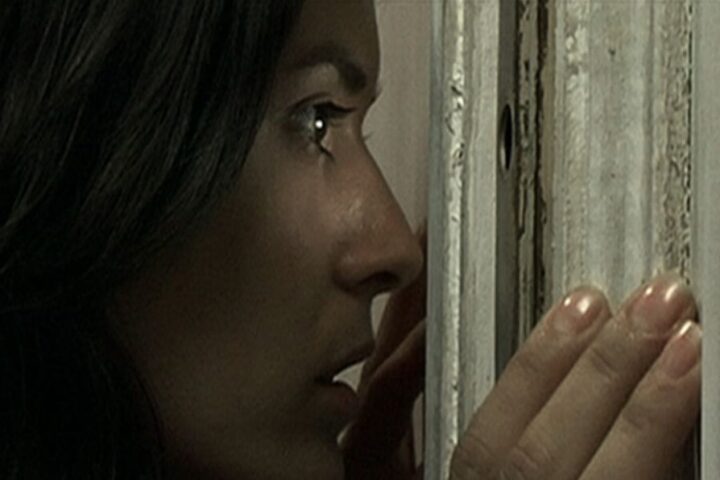
We first get a sign that trouble is afoot in the patch of suburban France where David Moreau’s MadS is set when a bandaged, mutilated woman (Sasha Rudakova) aggressively hops into 18-year-old Romain’s (Milton Riche) car after he pulls over to the side of the road. As Romain heads toward the nearest hospital, the woman, who’s unable to speak, is manic and paranoid, constantly looking behind her to see if she’s being followed.
Of course, Romain isn’t in the best state of mind himself, having just snorted a couple lines of a new party drug in preparation for a night out with friends to celebrate their recent high school graduation. As the woman becomes completely unhinged, wildly flailing about the speeding car and eventually stabbing herself in the neck multiple times, a transference seemingly occurs between her and Romain, though it’s difficult to tell right away if Roman is just suffering from a really bad trip or if he’s now afflicted by whatever condition she may have.
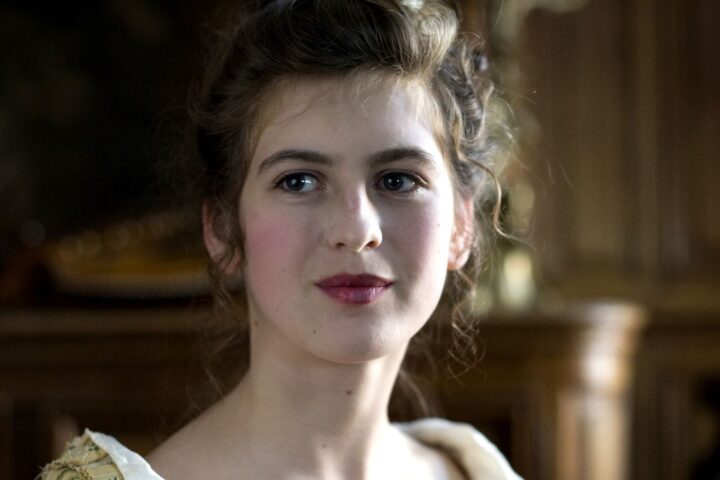
Unfolding in a single shot—or, at least, a canny simulation of one—MadS initially hitches its perspective to Romain, with the camera hovering around him as he eventually meets up with his girlfriend, Anaïs (Laurie Pavy), and some friends ahead of going to a party. The film will twice more switch narrative points of view—first following Anaïs, then her friend Julia (Lucille Guillaume)—each time soon after a character becomes infected. If the unbroken take feels gimmicky at first, it soon begins to contribute to the film’s increasingly oppressive atmosphere.
Throughout, we’re forced to follow, without interruption, as the characters are overtaken by an inexplicably twitchy rage, struggling to make sense of the violence that their bodies are seemingly being driven to enact. As the roving, handheld camera remains uncomfortably close to them, it comes to feel like a seeming extension of an inescapable physiological nightmare. And through it all, the film staves off a sense of repetition by having the actors articulate how the infection manifests itself differently in a host body due to personality traits or the degree to which a character knows that they’re clinging to the vestiges of their humanity.
While remaining yoked to three individual points of view, MadS also captures the horror of the world coming undone. It’s something that we come to feel in our bones as characters are overtaken by an aggression that they don’t understand but seem to intuit as irrevocable. The terror that we’re so intimately caught up in is at first intensified when Romain encounters armed agents looking to take him and his unnamed passenger out, and only becomes more expansive as Anaïs and Julia wonder through a city that appears to be under martial law, with the sound of distant bullets and military helicopters filling the air.
For what’s essentially a small, hyper-focused film—think the most famous scene from Andrzej Zulawski’s Possession stretched to feature length—it’s impressive how Moreau creates an all-consuming sense of dread and panic that almost sneaks up on you. And what begins as a night from hell for one teenager devolves into a nerve-wracking apocalyptic vision that nonetheless maintains its rigid, gripping focus on the characters’ limited, experiential realities.
Since 2001, we've brought you uncompromising, candid takes on the world of film, music, television, video games, theater, and more. Independently owned and operated publications like Slant have been hit hard in recent years, but we’re committed to keeping our content free and accessible—meaning no paywalls or fees.
If you like what we do, please consider subscribing to our Patreon or making a donation.