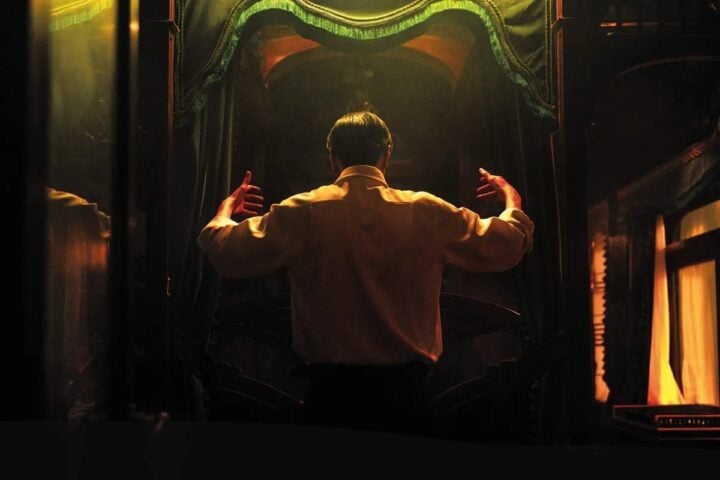
From the mid-1980s to the end of the 20th century, Hou Hsiao-hsien emerged as a kind of national historian, exploring Taiwan’s colonial history and attendant identity crisis across his work. Though his dramas of this period dealt with individuals and families, they tended to adopt a distanced, objective camera perspective with an emphasis on groups of people dwarfed by their physical and political surroundings. Eschewing close-ups, Hou ignored individual perspective to better study the tides of change playing on the characters as the accumulated weight of centuries of occupations shaped their sense of self and frequently alienated notion of belonging.
Hou took an opposite approach with 2001’s Millennium Mambo—that is, with a literally close-up portrait of an individual, Vicky (Shu Qi), navigating on-again, off-again romances with Hao-Hao (Tuan Chun-hao), the failed DJ and drug-using petty criminal with whom she shares an apartment, and Jack (Jack Kao), a kindly older gangster. Hou commits so thoroughly to her point of view that the film, set against the backdrop of Taipei’s clubs and cramped apartments, remains in soft focus at nearly all times, with the camera often moving and catching refractions of light through smoky dancefloors, security video, and mirrors. One shot shows Vicky and Hao-Hao making love in a haze of soft focus before the camera tilts up to watch them through a reflection, on which a blinking light obscures Vicky’s face, the tempo of the strobing speeding up as the couple nears climax and then slowing to a crawl when Hao-Hao orgasms.
Still, the film is no less keyed to the feeling of living through the perpetual churn of history as Hou’s two national epics, 1989’s City of Sadness and 1993’s The Puppetmaster. By focusing so intimately on Vicky, Hou captures the way that we have no idea how our lives, much less world events, will unfold, and it’s telling that even the woman’s narration, as she looks back on her life from a decade in the future, is as hazy as the film’s visuals, bringing into sharp relief minute emotions or off-handed observations but never finding meaning in what she experienced.
Millennium Mambo is in many ways a thematic foil to Hou’s Flowers of Shanghai. That film captured a fin-de-siècle ennui of a different century and milieu—of a dying old-world system of aristocrats and mercantile-class men wiling away their days inside a brothel, smoking opium and toying with the emotions and hopes of the courtesans who wait on them. Here, the amber oil lamps, ornate classical interior design, and traditional music have been replaced with fluorescent lights, bars and clubs indistinguishable from those in the West, and throbbing techno. In place of opium are ecstasy and speed, performing the same function for a comfort class unsure of what it wants but strongly suspecting it’s all downhill from here.
In Millennium Mambo, Hou sublimates his theme of national identity into an acknowledgment of the unremarkable facts of everyday Taiwanese experience. Not for nothing does the first scene depict a magician entertaining Vicky and her friends in a restaurant and the man proving his bona fides by showing the Taiwanese diners a certificate with a message printed in simplified Chinese with full text in English. “It looks more professional,” he explains to them.
Elsewhere, Japan’s colonial impact on Taiwan is evident in background details like the Hello Kitty doll in Vicky and Hao-Hao’s apartment. The upheavals captured in earlier Hou films have now consolidated in Millennium Mambo into a gnawing sense at the back of the mind that the question of what, exactly, Taiwan is hasn’t been answered so much as politely ignored. How can anyone figure out their national identity when it’s impossible enough to know yourself?
Image/Sound
Millennium Mambo arrives on Blu-ray from a recent 4K restoration that maximizes the intensity of its colors and finds detail in even the most deliberately hazy images. Blues in particular radiate off the screen, from the opening in which Vicky traipses down a tunnel to the scenes set in Taipei’s strobe-lit dance clubs. Facial close-ups have a sharpness that’s absent on DVD editions of the film, and black levels have none of the crushing artifacts that riddle those prior releases. On the audio front, the disc comes with DTS-HD Master 5.1 surround and 2.0 channel stereo tracks. Both are enveloping mixes, keeping the dialogue clear in the center channel and ably balancing it with the ambient electronic dance music and crowd noises.
Extras
On his commentary track, Rolling Stone film critic K. Austin Collins notes that this was Hou Hsiao-hsien’s first film to receive theatrical distribution in the United States before then thoroughly tracing all the ways in which this ostensible outlier in the filmmaker’s canon contains numerous aesthetic and thematic trademarks that he had developed over the preceding two decades. Also included on the disc is a video essay by critics Adrian Martin and Cristina Álvarez López, who unpack the film’s visual vocabulary and underlying themes.
Overall
Kino Lorber brings Hou Hsiao-hsien’s kaleidoscopic masterpiece to Blu-ray with a gorgeous transfer and a few illuminating extras.
Since 2001, we've brought you uncompromising, candid takes on the world of film, music, television, video games, theater, and more. Independently owned and operated publications like Slant have been hit hard in recent years, but we’re committed to keeping our content free and accessible—meaning no paywalls or fees.
If you like what we do, please consider subscribing to our Patreon or making a donation.