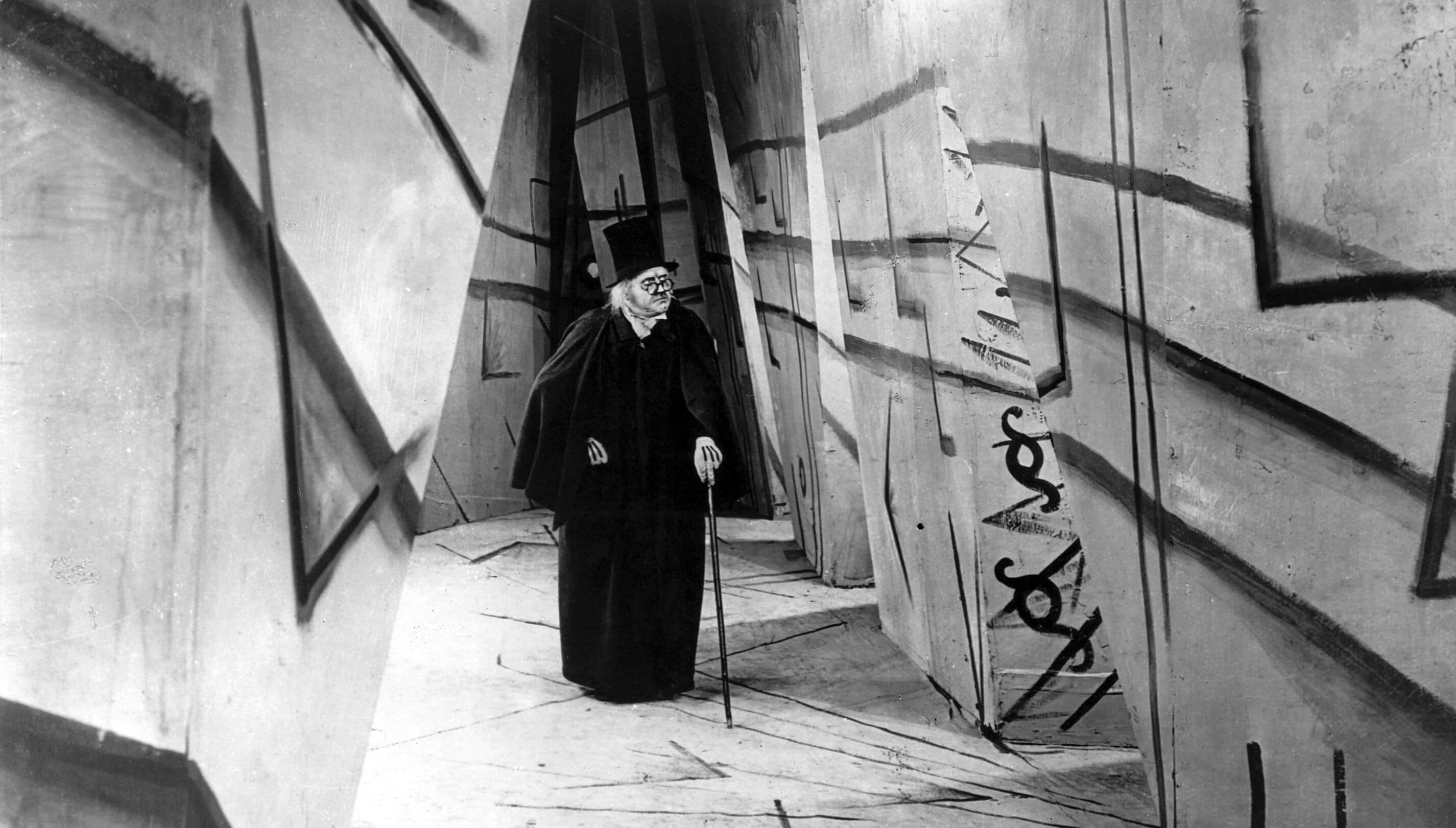
Subjective trauma becomes subaltern desire in The Cabinet of Dr. Caligari, Robert Wiene’s proto-horror silent classic that’s justly, if mostly, celebrated for its Expressionist, practically vertiginous images. By focusing almost exclusively on its pioneering formalism, the more historical and socially neutral readings of the film, aside from the work of scholars Alexander Doty and Harry Benshoff, have lost sight of its thoroughly embedded queer narrative.
Cesare (Conrad Veidt) is a murderous somnambulist under Dr. Caligari’s (Werner Krauss) control. Cesare is first glimpsed, outside Caligari’s tent at the local carnival, as a life-sized drawing that makes a caricature of Veidt’s slender face, to the extent that his cheeks are exaggeratedly shrunken in, perpetuating an effeminate stereotype indicative of physiognomic depiction. Cesare’s actual face is first glimpsed in close up, eyes closed as he furrows his brow and slightly moves his lips. Once his eyes open, he stares directly into the camera. Such an introduction, in relation to the previous drawing, reveals Wiene’s explicit framing of Veidt’s features as feminized because he’s merely a vessel for Caligari’s hegemonic control.
There are historical reasons to understand Veidt’s casting as intended to accentuate this line of thought—namely his role as a gay musician in 1919’s Different from the Others, which was heavily cut and altered by German censors. Veidt’s physicality became affiliated with non-normative sexuality from these very controversies, which take significant root in The Cabinet of Dr. Caligari’s most visually dynamic sequence, where Veidt’s body is made just as askew as the sets. As Cesare creeps along the outer walls of Jane’s (Lil Dagover) bedroom, his right arm is as distended as the jagged shadows and light behind him. His body isn’t simply an extension of the expressionist image, but a corollary to it. No other character in the film moves like Cesare, whose body is the only object of sustained contemplation throughout.
Carl Mayer and Hans Janowitz’s script understands Caligari as a fascistic type given to ensnaring those around him with carnivalesque brio. (His deceit is circuitous in nature, and of a piece with Wiene’s extensive use of crosscutting to join the film’s narrative lines.) He’s a man of legend, whose tale is inscribed within a book found by Francis (Friedrich Feher) late into the film, at the moment in which he discovers Caligari the carnival ringleader is also Caligari, director of the local insane asylum: a ringleader of a much more insidious, juridical sort.
Francis unveils the mystery as Caligari grows increasingly driven to madness, certain that he must “become Caligari,” in one of cinema’s most virtuoso sequences, wherein the phrase “du musst Caligari warden” literally encircles the unhinged doctor. Caligari isn’t simply a character, then, but an idea that takes throat-clenching hold within the film and emanates from it with a force that queers the very notion of stability and identity.
There’s also the matter of the frame narrative. In essence, it presents Francis as the truly crazed one, with a final revelation that the entire film has been, essentially, the ravings of a mad man, who has recast his cellmates as characters in a twisted rationalization for his own innocence. (In his 1947 book From Caligari to Hitler, Siegfried Kracauer argued that the frame story was added against Mayer and Janowitz’s wishes.) Perhaps the turn undermines Mayer and Janowitz’s more stringently political interests, but it illuminates the manner in which cinema speaks, in an avid, polymorphous manner, to a libidinal correspondence between meaning, movement, drive, and politics. A film-by-committee, but, even so, The Cabinet of Dr. Caligari remains cinema’s preeminent embodiment of dream-screen anguish.
Since 2001, we've brought you uncompromising, candid takes on the world of film, music, television, video games, theater, and more. Independently owned and operated publications like Slant have been hit hard in recent years, but we’re committed to keeping our content free and accessible—meaning no paywalls or fees.
If you like what we do, please consider subscribing to our Patreon or making a donation.