Context, across Sergei Loznitsa’s Babi Yar. Context, is largely provided by sounds and images rather than words. Although the documentary is by no means without language, the only spoken words come from within its footage. Sourced from German, Russian, and Ukrainian historical archives and personal collections, and taken between June 1941 and December 1952, this footage documents the before and after of the September 1941 massacre at Babi Yar, in which Nazi soldiers murdered 33,771 Jewish people.
Throughout, Loznitsa abstains from any form of contextualizing that would involve historians or talking heads speaking about the events with the benefit of hindsight. Instead, he constructs a linear, timeline-oriented documentary that horrifyingly explicates how human atrocities are made, step by step, through racist fearmongering and nationalistic fervor.
Few archival-oriented documentaries achieve the urgency of Babi Yar. Context. As Loznitsa’s film opens in June 1941, bombs explode in Soviet Ukraine, presaging the arrival of German troops in Lviv. A sign has been posted: “Glory to Hitler!” Shortly thereafter, the Ukrainian militia, acting on orders from German authorities, gathers and executes local Jews, who are accused of collaborating with both Soviets and the Soviet secret police.
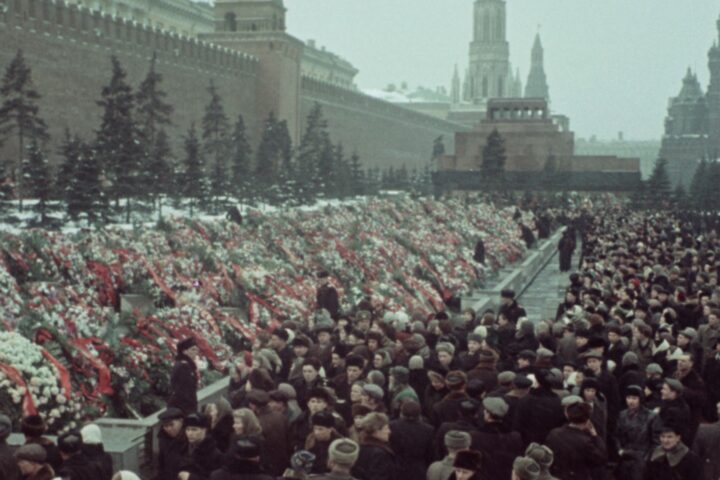
Loznitsa opts for intertitles as a means of contextualizing the imagery, less so the circumstances of the conflict or even the names of important figures. When various Soviet leaders take the podium in July 1944 to “celebrate” their victory over “the German fascists,” the filmmaker doesn’t even provide the context of names to go with the speakers.
The premise of context as a historical necessity, then, becomes a matter of interpretation. Loznitsa denies certain immediate forms of knowledge, such as names and background information, in order to make the images more urgent in how they reveal faces, places, and time. There are no ominous tones on the soundtrack or accompanying commentary to the footage of German Governor-General Hans Frank visiting Lviv in August 1941, as Loznitsa believes that the historical record should be accepted as a matter of fact.

Babi Yar. Context similarly utilizes smaller moments to suggest the scope of the Germans’ hatred and sadism. In a particularly haunting passage, women from Kiev collect their husbands from a labor camp. As the men are told that they may return to their families, there’s a fleeting sense of relief that at least a few lives are being spared, but it’s all false hope, given how Loznitsa integrates this moment into the film to foreshadow the heinous genocide that will soon be carried out on other Ukrainian citizens. With blistering clarity, Loznitsa shows how the Nazis’ violence was every bit as physical as it was psychological.
One of the film’s more chilling visual choices involves a notice advising all Jewish peoples of Kiev to gather their belongings, valuables, dress warmly, and meet at a designated location. Loznitsa homes in on the message, as if it were an intertitle, and scrolls down until reaching the end. It’s this sort of to-the-point approach that defines much of Loznitsa’s spare style; the words on the paper stand-in for unconscionable bloodshed. Over the span of the two days that followed, 33,771 Jews would be murdered and dumped into the Babi Yar ravine.
At this point, Loznitsa uses several photos taken during the aftermath of the massacre as its sole representation in the film. Following this, he inserts an intertitle, taken from an article titled “Kiev Now” from a Volhynia newspaper, celebrating the violence and explaining how, “Kiev, liberated from oriental barbarians, breathes freely and begins a new life.” By using actual documents and images from the time as its source of commentary, the film essentially argues that contemporary tongues cannot speak to the horror of nativism that fueled the massacre at Babi Yar with the same power as archival materials.
The film’s final half hour documents the trial and execution of German participants in the massacre with a procedural logic that culminates in real-time archival footage of the hangings, where thousands of Ukrainians gathered and cheered at the sight of German soldiers twitching and choking to death. It’s also the sequence with the most audible language, as various testimonies given at the trial, one from a Jewish woman who pretended to be dead for eight hours to avoid death, another from a German soldier who used a submachine gun to murder hundreds of Jews, attest to the chaos of the massacre as it unfolded. With Babi Yar. Context, Loznitsa continues to mine the archives for what amount to living documents of a past that, as is all too clear, reverberate into the present with devastating force.
Since 2001, we've brought you uncompromising, candid takes on the world of film, music, television, video games, theater, and more. Independently owned and operated publications like Slant have been hit hard in recent years, but we’re committed to keeping our content free and accessible—meaning no paywalls or fees.
If you like what we do, please consider subscribing to our Patreon or making a donation.