If you live primarily online, it’s easy to assume that America is entirely populated by individuals hell-bent on destroying one another, particularly in the name of culture war solidarity. This friction is real, yet humans in the wild tend to be more empathetic, less contentious, and less reductive than the media vortex would have us believe. There’s big money in telling us what we want to hear, stoking our biases until we’re subscribing on a daily basis to our own custom reality. There’s great potential for satire in this insidious brand of divide and conquer, and B.J. Novak attempts to mine it in his feature-length directorial debut.
Vengeance’s trailers suggest that the film will be a romp in which a pretentious East Coaster gets in over his head with a bunch of wily Texans because, well, are there any other kind of Texans in the world of movies? Or any other kind of East Coasters for that matter? These sorts of binaries are ideal grist for farce, yet Novak is hunting bigger game.
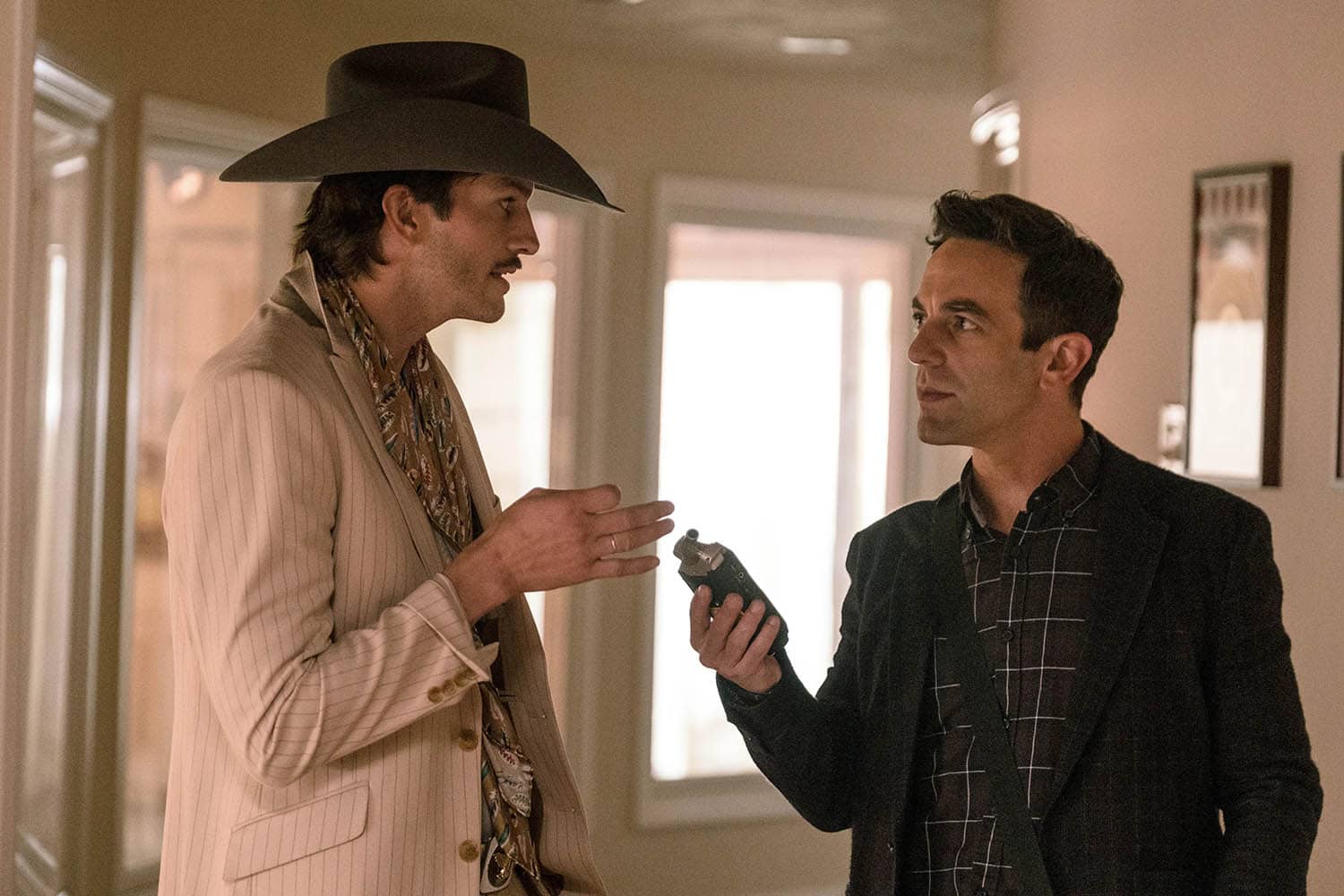
For a while, though, the filmmaker practices the same misdirection as Vengeance’s trailers, reveling in broad social contrasts. Ben Manalowitz (Novak) writes for, natch, The New Yorker and enjoys a robust secondary career as a womanizer. He yearns for more, however, wanting to sell a story to a podcasting company run by Eloise (Issa Rae) that cuts to the heart of America’s divisions. Early in the film, Ben pitches an intriguing angle for a podcast: how online culture has placed each of us in a different time zone, as technology enables everything with a click and a whim, from watching TV to having a conversation. Via texting, we don’t even have to communicate simultaneously. Which is to say that Ben, and Novak, have found a way to articulate how mental alienation is brought about in part by minute physical textures.
Ben is told that he has a theory rather than a story, though the latter soon comes knocking. In the middle of the night, a stranger named Ty (Boyd Holbrook) calls Ben to announce that the former’s sister, Abilene (Lio Tipton), is dead. Abilene is a hookup that Ben barely remembers, but Ty believes him to have been a serious boyfriend. Ben finds himself in West Texas at Abilene’s funeral, pitching a new podcast to Eloise about America’s need for conspiracy theories. Abilene apparently overdosed in an oil field, while Ty insists that she was murdered. Ben is thrust into the role of detective and alien from another world then, discovering among other things that Abilene was a remarkable woman. He might’ve known that earlier had he not brushed her off, relegating her to an endless queue of media-enabled distractions.

That is an elaborate setup for a comedy, but Vengeance isn’t really a comedy. Novak and Ben are impossible to differentiate, as the former shares the latter’s need to elucidate the culture wars. Novak resists, to a certain extent, turning Ty and his family into raging, gun-happy, anti-intellectual, Trump-loving stereotypes. Yet Novak’s carefulness is its own form of condescension, as this family exists to teach Ben a lesson about life outside of New York City. Novak defines these characters less as people than as totems to his own tolerance.
Parts of the American South feel gloriously disreputable as well as dangerous, and while Novak allows for that danger, there’s something skittish about how he handles Ben’s collision with this world. The film could use the demented—and, yes, political—will of Robert Zemeckis’s Used Cars or Adam McKay’s Talladega Nights: The Ballad of Ricky Bobby, the latter of which is namechecked. In those movies, the filmmakers ride clichés until they’re bucked, risking offensiveness and more for a punchline. By contrast, Novak wants you to know he cares. He’s as straitjacketed and self-conscious as, well, a stereotypical limousine liberal.
If Vengeance isn’t a comedy, what is it? For one, it suggests a podcast with a televisual component. Ben meets kooky characters and learns that he’s a selfish douche while ostensibly trying to solve a mystery. That self-absorption is common in podcasts and overripe for satire, yet Novak offers Ben’s quest up with a more or less straight face. In fact, a fictional podcast might’ve been an ideal form for this material as Novak approaches it here, as he has a gift for beautiful and surprising reveries that offer new perspectives on media-addicted America.
But these soliloquies, particularly a wonderful rumination on the nature of sound, delivered by a record producer played by Ashton Kutcher with career-redefining gravity, exist unto themselves, stranded by a plot that never catches fire. This lack of emotional escalation could be charitably read as intentional; after all, mediated self-isolation is Vengeance’s governing theme. But Novak’s preaching grinds the film to a repetitive halt. Like many fledgling writer-directors, Novak hasn’t yet found a way to dramatize, rather than verbalize, his obsessions.
Since 2001, we've brought you uncompromising, candid takes on the world of film, music, television, video games, theater, and more. Independently owned and operated publications like Slant have been hit hard in recent years, but we’re committed to keeping our content free and accessible—meaning no paywalls or fees.
If you like what we do, please consider subscribing to our Patreon or making a donation.