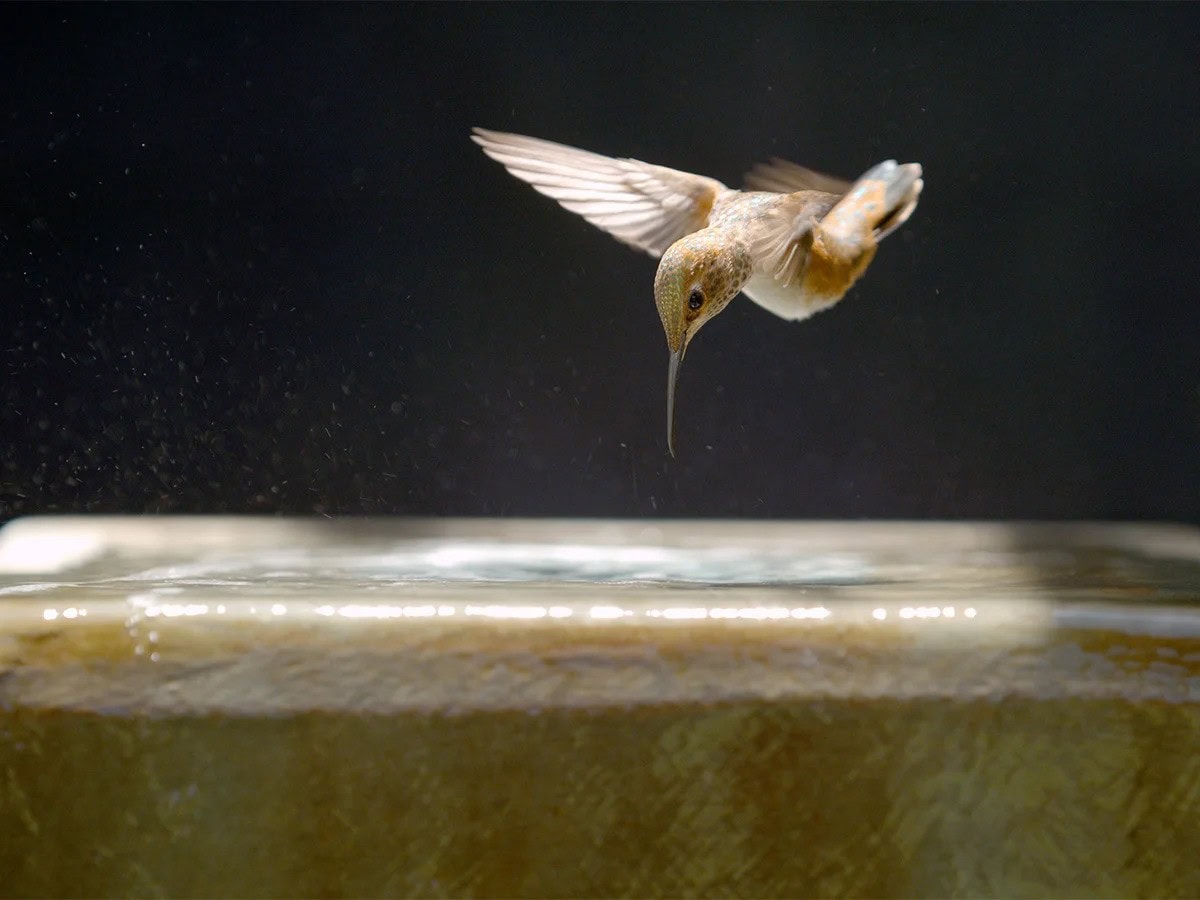
“It’s a hard world for small things,” says Lillian Gish’s Rachel Cooper in The Night of the Hunter. Those words come to mind while watching Sally Aitken’s modestly informative and gently profound Every Little Thing about a Los Angeles-based hummingbird rescue. If there’s any fault to be found in this aptly titled documentary (here, the concern for the minuscule extends to the film’s title being spelled in lower-case letters), it’s that it doesn’t exactly benefit from its formulaic voiceover and other supplementary audio. The footage of hummingbirds—usually in slow motion—is intrinsically commanding and in little need of buttressing, particularly with adjectives that fall far short of the images they accompany.
Terry Masear is a wildlife rehabber who, along with others in her field, rises to the seemingly nonstop challenge of caring for L.A.’s fragile population of hummingbirds, who are so delicate in their form that even a cautious rescuer might impact a bird’s survival chances. The birds are given names like “Raisin,” “Wasabi,” and “Larry Bird”—a touch of whimsy that stands in stark contrast to the immensity of the odds stacked against them. (It’s no surprise that Masear’s facilities include a hummingbird cemetery.) Even a benign-seeming invention like a skylight window poses a threat to mother birds whose instinct is to move upward toward the sky, even after they’ve found themselves indoors, to forage for spiderwebs and other nesting materials.
Masear’s experience as a victim of childhood abuse is succinctly and broadly addressed, underscoring a largely unspoken meta-narrative about the necessity of compassion and forgiveness, but much like the filmmakers, she appears more comfortable defining herself through her present undertakings. Frankly yet tastefully addressing how she copes with the inevitable loss of some of her avian patients (such as her learned reticence to bond with birds with poor survival chances), she embodies a sobering wisdom and maturity.
Every Little Thing uses a combination of digital and film images, including what appears to be faux-16mm footage—a dynamic visual scheme that may look random but feels organic. This piecemeal construction mirrors the bird nests seen throughout the documentary, exquisitely engineered assemblages of twigs, lint, human hair, and paint chips. While it’s a pity more space wasn’t afforded for the birds themselves, whose personalities shine through in their eyes and the flicking of their tongues such that they would upstage nearly any human co-star, the film’s unabashed humanity usurps even its most treacly touches.
Since 2001, we've brought you uncompromising, candid takes on the world of film, music, television, video games, theater, and more. Independently owned and operated publications like Slant have been hit hard in recent years, but we’re committed to keeping our content free and accessible—meaning no paywalls or fees.
If you like what we do, please consider subscribing to our Patreon or making a donation.