
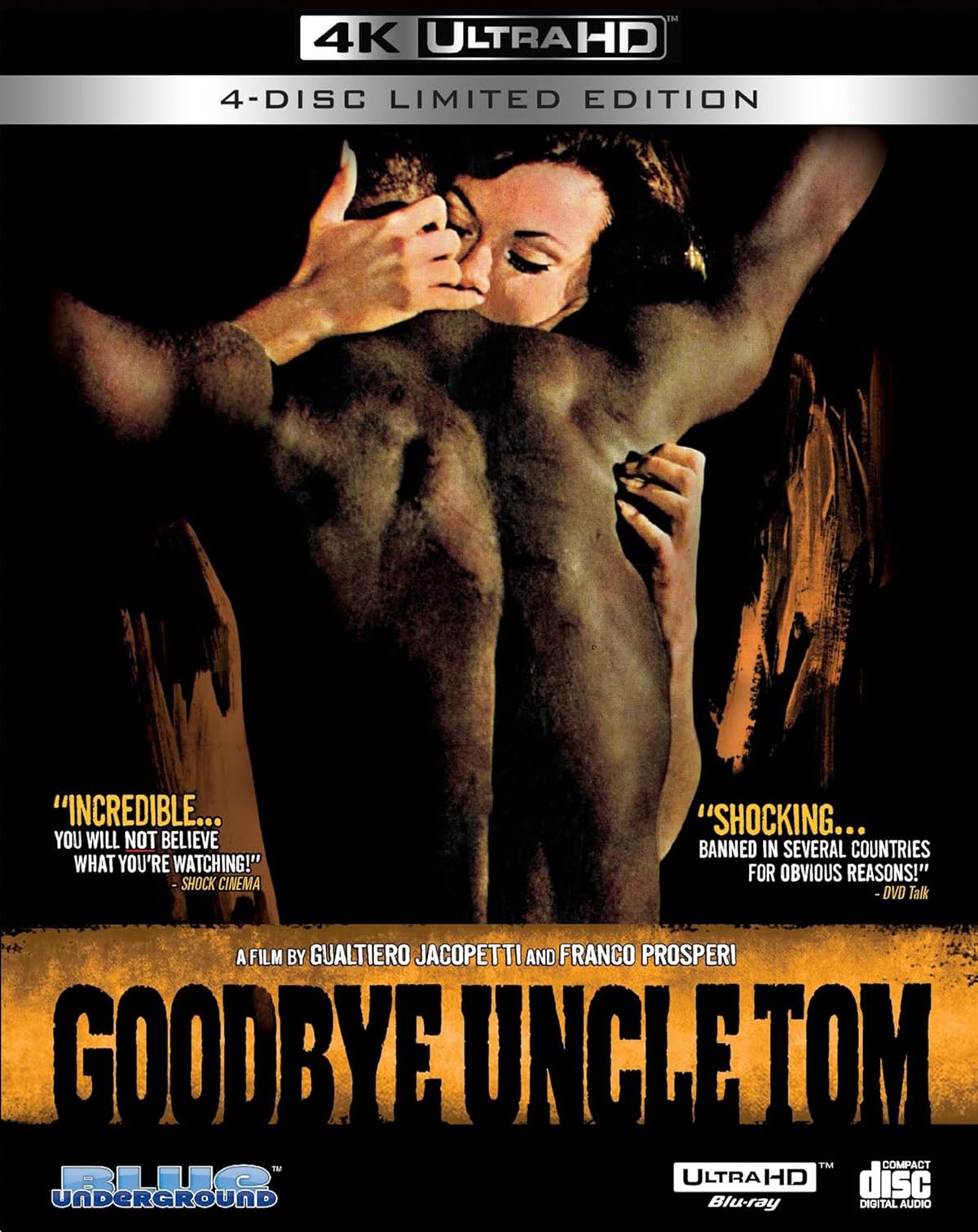
 Gualtiero Jacopetti and Franco Prosperi achieved notoriety in 1962 with the sensationalistic documentary Mondo Cane, a globetrotting exposé of bizarre rites and other human grotesqueries that opened the floodgates for a deluge of Mondo titles. When the release of their 1966 film Africa Addio (a.k.a. Africa: Blood and Guts), a despairing look at the continent’s decolonization movements, led to accusations of racism, Jacopetti and Prosperi sought to address the charges by revealing (some would say reveling in) the history of slavery in America. The resulting film, Goodbye Uncle Tom, is an extremely disturbing, at times almost unwatchable, descent into the inferno of an unpardonable institution.
Goodbye Uncle Tom leaves any pretense of objectivity behind in the dust. Using a conceit similar to such Peter Watkins classics as Culloden and The War Game, Jacopetti and Prosperi’s film brings modern-day documentary technology back into a historical setting, using it in this case both to interview historical personages on the subject of slavery and record everyday institutional practices. As outrageous and horrifying as these can get, it’s even more discomforting to realize that the quotes and facts espoused are all demonstrably accurate.
Like the Air Cav in Francis Ford Coppola’s Apocalypse Now, Jacopetti and Prosperi arrive by helicopter at a Southern plantation, the propellers kicking up clouds of dust in the cotton fields, and knocking off the bonnets of the ladies assembled on the lawn as a welcoming committee. The endlessly roving camera serves as their subjective POV throughout the film (often using wildly distorting wide-angle shots), while we hear the filmmakers’ observations in voiceover. A lavish dinner party in their honor allows for the first round of sardonic pronouncements on slavery from guests whose identities are clearly established for the historical record.
Goodbye Uncle Tom frequently has its Black characters gaze into the camera, returning our gaze in a way that’s clearly meant to implicate them even further in the on-screen atrocities. Jacopetti and Prosperi use other alienation effects. The only time we actually see them is when they pose as big game hunters tracking down escaped slaves. The sequence concludes with them standing next to a large pile of bodies. But then the final shot shows the extras standing up and brushing themselves off. After all, this isn’t a documentary. There’s also a vein of mordant humor that runs through certain scenes, always at the expense of the white characters.
As with even the most brutal Italian exploitation films (Cannibal Holocaust, here’s looking at you), Goodbye Uncle Tom is exquisitely photographed, boasting some gorgeous natural vistas that serve as counterpoint to the unrelenting depravity on display. Composer Riz Ortolani’s often shimmeringly gorgeous score further emphasizes the idea of tonal contrast. (Ortolani also scored Cannibal Holocaust.) What’s more, the attempts at humor work not so much to leaven the film’s horrors but rather to sharpen its satirical sensibilities.
The final 20 minutes of Goodbye Uncle Tom flash forward to Miami circa 1970. A militantly dressed Black man walks around the city while perusing a copy of William Styron’s Pulitzer Prize-winning novel The Confessions of Nat Turner, then a recent publication. While excerpts are read aloud, the man imagines acting out Turner’s saga of slave revolt and slaveowner massacre. Styron’s book is a work of fiction based on the historical record, in a way that directly echoes the film’s own approach. The play of fact and fiction in Goodbye Uncle Tom is like two mirrors, both true and untrue, reflecting each other into an infinite abyss.
For this new release, Blue Underground includes both the 123-minute Goodbye Uncle Tom, as well as the longer 136-minute Italian cut titled Addio Zio Tom, each available on separate UHD discs. The major difference between the two versions consists of an extended prologue in the Italian cut that explores the aftermath of Martin Luther King Jr.’s assassination, the tenets of the Black Power movement, and the views of one wealthy Southern matron that dovetail quite nicely with those of her forebears. The fact that the Italian version starts off in the present day also makes more sense of the film’s closing leap back into modernity, effectively bookending the historical material with its contemporary consequences.
Image/Sound
The 2060p UHD transfers of both Goodbye Uncle Tom and Addio Zio Tom look fantastic, a vast improvement over the 2003 DVDs. Colors are exceedingly vibrant, flesh tones lifelike, and black levels deep. The image possesses some genuine depth and reveals lots of new details of the period costume and décor. Audio comes in English or Italian DTS-HD Master Audio mono, depending on which cut you’re watching. Both sound solid and admirably convey composer Riz Ortolani’s poignant score, featuring the plaintive theme “Oh My Love” sung by Katyna Ranieri that also features prominently in Nicolas Winding Refn’s Drive.
Extras
The extras are all featured on a third 1080p HD Blu-ray disc. There are two feature-length documentaries to give you a thorough grounding in the mondo movie genre and the men who started it all. Directed by David Gregory, The Godfathers of Mondo is an excellent overview of the careers of Gualtiero Jacopetti and Franco Prosperi, rife with information on the making of each of their movies, and bolstered by talking head informants including the two filmmakers, production manager Giampaolo Lomi, and regular composer Riz Ortolani. Andrea Bettinetti’s The Importance of Shocking delves deeper into the colorful life of Jacopetti, who speaks candidly about a number of different successes, scandals, and personal tragedies.
In a separate interview piece, Jacopetti, Prosperi, and Ortolani talk about wanting to adapt Mandingo, filming Goodbye Uncle Tom in the United States and Haiti, Jacopetti’s run-in with the F.B.I., and the use of contrasts in writing the film score. Elsewhere, author and academic Mark Goodall discusses the history of the mondo movie, and the questionable decision to shoot in Haiti. This latter point is expanded on at great length by Professor Matthew J. Smith, who articulately excoriates the film and its filmmakers, as well as provides the requisite historical background for the Duvalier regime that autocratically ruled the country at the time.
Also included on a fourth disc is a 23-track CD that contains Ortolani’s original motion picture soundtrack. Deluxe packaging includes an embossed slipcover, reversible sleeve with alternate artwork, and collectible booklet featuring an essay by critic Dan Madigan.
Overall
Gualtiero Jacopetti and Franco Prosperi’s Goodbye Uncle Tom plunges you headfirst into the dark heart of race relations in America. What’s worse is that it’s still altogether timely.
Since 2001, we've brought you uncompromising, candid takes on the world of film, music, television, video games, theater, and more. Independently owned and operated publications like Slant have been hit hard in recent years, but we’re committed to keeping our content free and accessible—meaning no paywalls or fees.
If you like what we do, please consider subscribing to our Patreon or making a donation.



It was an improvement upon the DVD you say – I’d be interested to know if it was an improvement upon the existing blu-ray.